The non-work half — health, longevity, mind, money, reading, routine — picked for your actual life (the 2027 travel year, health-as-keystone, the road to the wedding & kids). The rest was viral bait and impulse saves.
Tim Ferriss
@tferriss · Oct 27, 2023
Travel
Why thisYou’ve got the 2027 unpaid-leave travel year on the horizon (keeping cash liquid for it). This is the origin-story version — 18 months, one suitcase, two books. Worth a re-read while you’re planning the trip.
Starting in 2004, I traveled the world for roughly 18 months. The lessons learned formed the basis for much of The 4-Hour Workweek.
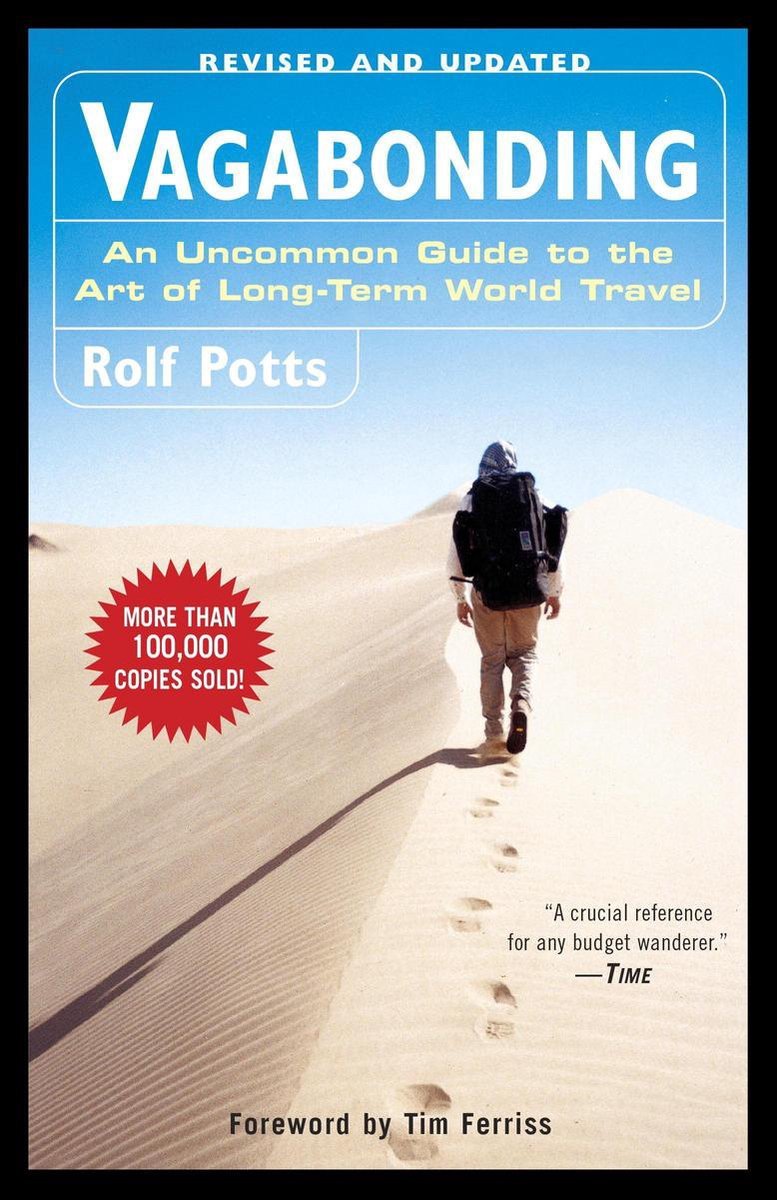
On my journey—from the back alleys of Berlin to the hidden lakes of Patagonia—I had next to nothing: one suitcase, one backpack, and only two books. One of those books was Walden by Henry David Thoreau (naturally), and the other was Vagabonding: An Uncommon Guide to the Art of Long-Term World Travel, written by Rolf Potts (@rolfpotts).
Vagabonding easily remains in my top-10 list for life-changing books. Why? Because one incredible trip, especially a long-term trip, can change your life forever. And Vagabonding teaches you how to travel (and think), not for one trip, but for the rest of your life.
In my own dog-eared copy of Vagabonding, I have notes, underlines, and highlights on practically every page, ranging from the tactical (how to pack intelligently, what to bring, what not to bring, where to go, etc.) to the philosophical (the Upanishads, how to slow down after a lifetime of rushing and caffeine, etc.). I also have a wish list of dream destinations on the inside cover, including places like Stockholm, Prague, Paris, Munich, Berlin, and Amsterdam. The list goes on and on.
Using the Rolf’s tips, I checked them all off. I was able to explore many of them for 2-3 months at a time at my own pace, unrushed and unworried. It was a dream come true.
Everything in Vagabonding works. This book changed my life completely, and I wish the same for you.
Why thisYou make good money as a contractor; this is the ‘spend it on your health’ list. Some of it is over-the-top, but the framing — health is the one asset you can’t buy back — fits your steps-as-keystone thinking.
The best thing to do when you make good money:
Invest in your health.
Without it, you are nothing.
Here’s the ultimate list of 20 premium purchases for elite health and performance:
1) 50-Parameter Blood Testing https://t.co/dRBM98NOBQ
Why thisA clean one-per-category reading shortlist — Outlive (longevity), The Psychology of Money, Atomic Habits. A no-deliberation pick-list for your next book.
Stop wasting hours looking for the perfect book, just pick one of these:
Health: Outlive
History: Sapiens
Sales: $100M Offers
Habits: Atomic Habits
Stoicism: Meditations
Creativity: The War of Art
Productivity: The ONE Thing
Investing: The Psychology of Money
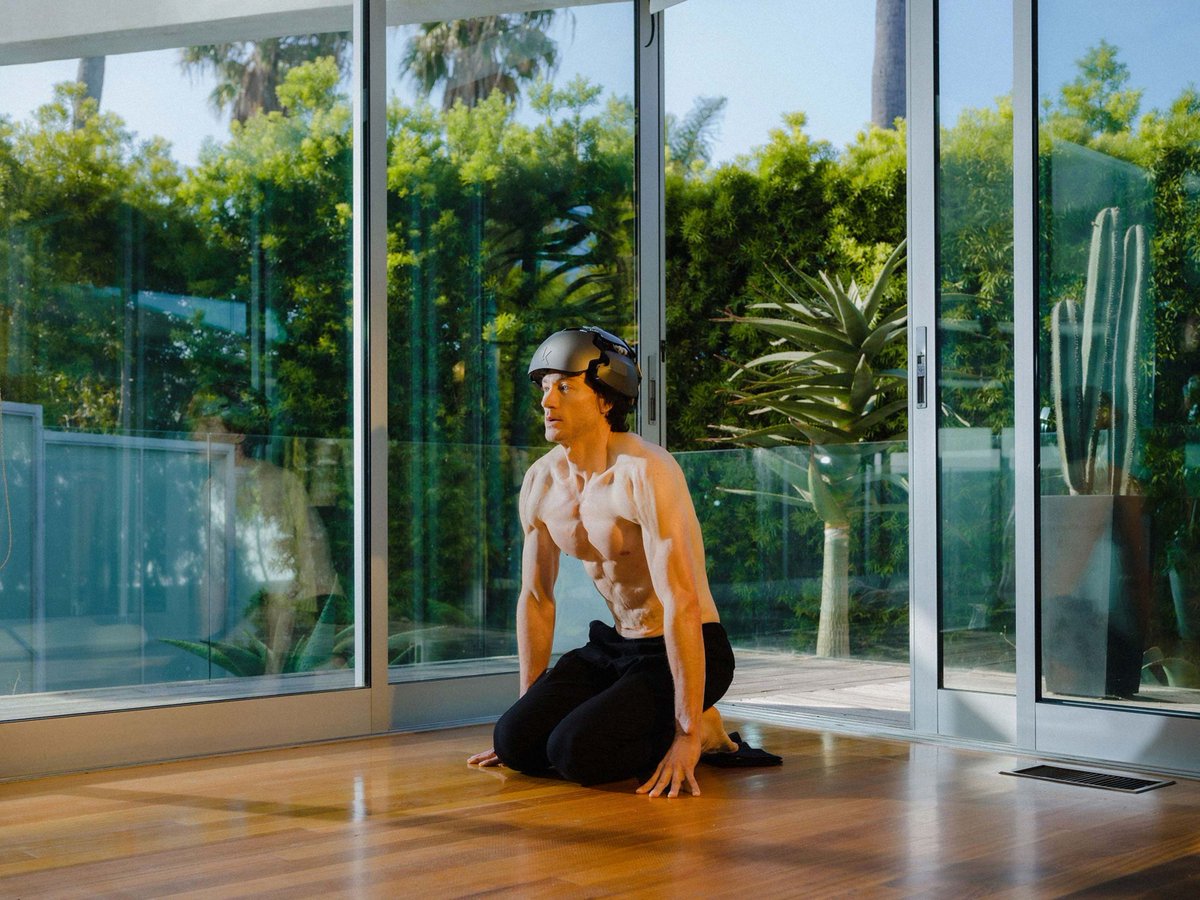
Why thisThe Bryan Johnson ‘Blueprint’ breakdown. You’re longevity-curious — treat it as a menu to cherry-pick from, not a protocol to copy wholesale.
Bryan Johnson sold his company to PayPal for $800 million in 2013.
Since then, he's been investing millions to reduce aging.
In 2021, he reduced his epigenetic age by 5.1 years in 7 months (World Record)
Here’s a breakdown of his “Blueprint” and my own experience with it: 🧵 https://t.co/igFya5JLiz
Why thisThe most-saved meditation thread on X for a reason — 15 hours/day for 6 months with a monk, distilled. Good for the stretches when you’re chasing calm/focus over the afternoon dip.
I meditated 15 hours a day for 6 months straight with one of the toughest Buddhist monks on the planet.
Here's what I learned: https://t.co/E3DntSxwDY
Why thisWhy time speeds up with age — compression by habit/craving/planning, and that you can train to feel it. A sharp, non-woo take on attention and presence.
meditation can fix this, and i dont think the explanation you quote tweeted in your reply that “each year is a smaller % of your life.” is the real explanation
time speeds up because experience gets compressed by habit, craving, aversion, planning, selfing. these create conditionings most people can't feel, but are there, and you can train to feel it
lsd is the obvious proof point: temporarily loosen the conditionings and ~everyone reports time slowing down, things being more vivid, the world feels childlike again. because it is more childlike, you had fewer conditionings then. almost everyone with tens of thousands of hours of meditation practice reports ~2-3x slower time, more vivid experience, because something drops, which matches my experience too (this longevity benefit was a big motivation for doing it in the first place, and it basically did what the books claimed it would)
Why thisA credible, practice-first pointer into the jhanas (via Rob Burbea). If the meditation thread above lands, this is the deeper rabbit hole.
The Jhanas are real.
I used to deeply explore the Jhanas for ~4-6wk (mostly Rob Burbea's lectures), and now I have mostly stopped (busy with other things atm). Writing down my thoughts about Jhana, my tips to my pre-Jhana self, lessons learned etc, while the memory is fresh.
The Jhanas are real. This is a crazy fact. All the things they say about bliss on demand, infinite blah blah, they're real. Hard to put to words obviously, but the closest phrase I have to convey the feeling is "infinite happiness" (on J3).
Jhanas are transformative. I have never seen anyone, not a single soul, who went into a spiritual lecture (any r*lig*on doesn't matter) and came out transformed. An actually different human being. But the Jhanas did that to me. Baseline happiness is ~10x, and when it's at its peak (in J3), it's just.. I have not found an IRL event that compares. [1]
I have not reached J4-J8. J3 is absolutely wonderful and lovely, it's a refuge from the world that I can access anytime I want. Tried going to J4 but I don't think the J3 is ripe yet. Tbh I'm not that interested in J5-J8. I successfully achieved J1 on busy coffeeshop couple times, and that suggests to me J1-J4 can be had anytime, anywhere. Which is absolutely wonderful.
Pre-J1, I tried metta, visualization, "energy body," and all kind of stuff (I forgot), and what got me into J1 is the simplest technique, which is breathing as Michael Taft suggested (search youtube). Ymmv, it's a good idea to try it all.
If I were to summarize:
- J1: under a waterfall, yellow, heavenly light
- J2: floating in a river, "head halo", pink cottonball
- J3: submerged in a lake, submerging hot iron into cool water
Water in this analogy is happiness
What each Jhanas revealed to me:
- J1: altered states exist and can be achieved purely through meditation
- J2/J3: infinite happiness is real, and it does not come from the outside world
The most important tip I have for my pre-J1 self when getting into Jhana is don't muck with anything. Don't touch anything. Things happen, the impulse is to panic, mess with it, poke it, etc. DON'T!!! I got a piti that would've evolved to J1 on my first day of my Jhana practice, panicked real hard, and the piti ran away. Took ~1.5wk before I achieved the same strong piti but later on I relaxed into the piti and boom J1. Another tip for my pre-J1 self: piti need not be "crawling," it's already everywhere surrounding you, you just have to tune into it like a radio.
The biggest hurdle was pre-Jhana to J1. After J1, the next Jhanas I experienced were just about letting things evolve (it's that simple, really). I learn all these by myself. The materials that helped me:
- tweets by @nickcammarata
- the Jhana blogpost by @nayafia
- Michael Taft technique (pre-J1)
- Right Concentration by Leigh Brasington
- tweets/talks by @jhanatech and blogposts of Jhourney's participants
- tweets by @bayeslord
- Rob Burbea's talks (post-J1)
I highly suggest you give it a shot (if you are inclined). The Jhanas are wonderful, and honestly idk why it's not taught to every single human being on Earth.
[1] It's not that a single Jhana event triggers transformation, it's a result of continuous, serious practice for weeks.
Why thisHigh signal-to-noise life-habits list — a capture system, Kindle-not-phone at night, one page a day. Several map onto things you half-do already.
30 short habits with massive return on life:
1. Create a system for capturing thoughts—your brain is for having ideas, not holding them.
2. Swap your phone for a Kindle at bedtime (this fixed 90% of my sleep problems)
3. Read something every day. Even just 1 page.
4. Write something every day. Even just 1 paragraph.
5. Automate small decisions/tasks. Save your brain power for bigger things.
6. Write a 5 item to-do list each morning. Prioritize it by importance.
7. Learn to use body scan meditation to fall asleep quickly.
8. Go to bed 30 minutes earlier.
9. If you want something—ask for it. Closed mouths don't get fed.
10. Keep a swipe file of things that resonate with you.
11. Break down problems into the smallest possible action steps.
12. Write down 1 story-worthy moment each day. In a month, you'll have 30 stories to tell.
13. Double down on creative activities that make you lose track of time.
14. Put your phone out of reach while you're working.
15. Track every minute of your day for a week. See where your time is actually going.
16. Be bored more often. Give your brain space to be creative.
17. Listen more than you speak.
18. Create more than you consume.
19. Compliment more than you complain.
20. Delete apps you don’t need.
21. Donate clothes you don’t wear.
22. Make a habit of reaching out to old friends.
23. Never say “yes” out of obligation.
24. Take care of your information diet—Junk info hurts our brains like junk food hurts our bodies.
25. Never do an activity just so you can tell others about it.
26. Revisit things that have brought you joy in the past. They'll do it again.
27. Stop comparing your behind-the-scenes to every one else’s highlight reel.
28. "Read what you love, until you love to read" - Naval Ravikant
29. Take care of your body, you only get one.
30. Leave it better than you found it.
Why thisYou keep a daily scratchpad already — this is the case for making it a ritual, plus 5 reusable morning prompts. Pen and paper, not an app.
The single most powerful habit for personal growth:
Journaling.
Over the past 5 years, I've journaled every single morning—and along the way, I've:
• Answered over 1,000 questions
• Tested every app, pen, & notebook
But I always return to a pen, paper, and these 5 prompts: https://t.co/bW3M9e9BXc
Why thisA refreshingly un-hardcore deep-work routine — no 5am, no ice bath. Just phone off, blockers on, two hours on the most important thing. Realistic enough to actually adopt.
My morning routine for 2 hours of deep work every day:
1. Get up at 7am
2. Walk my ass over the coffee shop
3. Order a large cup of the hot stuff
4. Sit down
5. Phone: OFF
6. Siteblocker: ON
7. Noise cancelling headphones: ON
8. YouTube megamix: ON
9. Pomodoro timer: ON
10. Then, I work on the MIT for 2 hours (most important thing)
That's it.
No 5am wakeup, no sauna, ice bath, meditation, blah blah blah.
By ~9:30am, I got the hard stuff done.
The rest of the day my ADD takes over and that's OK.
Why thisThe boring-but-true stack: heavy lifting, cardio, protein, less alcohol, 7–8h sleep → focus/energy/mood up. Reinforces the health keystone.
My life got exponentially better once I got my fitness and nutrition in order:
• Heavy lifting 5 days per week
• 3-4 days of cardio per week
• Counting my macros and eating a caloric deficit with high protein
• Cutting out 95% of alcohol intake
• 7-8 hours of sleep (pre newborn)
My focus, energy, and happiness have never been higher
Why thisPractical nervous-system resets — physiological sigh, humming, gargling (all vagus hits). Useful for the stressful-day / afternoon-crash moments.
My UPDATED top cortisol-lowering hacks when you’re trapped in a stressful environment (best first…fastest resets prioritized):
- Double inhale nose + long slow exhale pursed lips (3-5x
for instant reset)
- Gargle hard with water (or fake it) 30-60 secs throat vibration = vagus hit
- Hum whenever you feel the need (or bee breath…deep inhale, exhale “mmm” with ears lightly covered) drops stress fast
- Breath holds 15-20 secs OR box breathing OR 4-7-8 (inhale nose 4, hold 7, exhale mouth 8)…vagus hit
- Cold spoon/ice cube on face/neck OR splash cold water OR dunk face in sink 10-30 secs to lower parasympathetic
- Massage ears/head/neck/shoulders while humming
- Clench & release fists & feet…tense hard 5-7 secs then release with long exhale
- Reframe: “this is just adrenaline doing its job” (Feeling Overrides Nutrition style…sensations aren’t danger)
- Tongue on roof of mouth + gentle swallow x a few
- Tense glutes/thighs hard 5-7 secs & release with long exhale
- Self hug or lymph massage (pro tip: add humming)
- Humming + eye rolls/soft gaze OR quick left-right eye scan 10x while long exhales
- Warm shower then finish with cold face splash
- Quick carb/protein/salt snack
- Coke/coffee w milk & sugar if you handle it well
- Sip sweet & salty slowly while slow exhales
- Belly laugh attack… look at a meme/clip that makes you giggle
- Silly face in mirror while humming…instant mood flip
- Shake it out like wet dog…full-body shimmy 10-20 secs (discharge stress substances)
- Fake evil laugh (muahaha!) 20-30 secs = vagus hit
- Grounding: plant feet flat, rock side-to-side gently while long exhales…feel the floor holding you
*All free, anywhere-doable, heavy on breath/vagus/laugh/shake stack that actually moves the needle in real time. Test next panic…report back which ones work best for you*
Why thisOn why you doomscroll — and that the fix is building easier sources of pleasure, not willpower. Fitting, given we’re literally digging through your bookmark graveyard right now.
The impulse to doomscroll comes from the fact that the brain’s dopamine system has identified your phone screen as a reliable source of pleasure.
One of the best short term ways to overcome this impulse is to establish healthier reliable sources of pleasure that are just as easy to access.
One way to do this is to learn how to become more sensitive to pleasure in your body.
You can do this via formal sitting sessions where you look inwards and patiently learning how to notice and cultivate pleasure in your body.
You can also do it by paying more attention to sensations of pleasure in you body as you go about your day.
Eventually, as your sensuality to pleasure in your body increases, your body will start to rival you screen as a reliable source of immediately accessible pleasure.
Then, every time you feel an impulse to grab your phone you can redirect that impulse towards finding and connecting to pleasurable sensations in your body.
Over time you can establish a new mental routine this way and rewire you brain’s reward system.
Positive techniques like this I think tend to work better than just trying to grit your teeth and resist addictive patterns without anything to replace them.
@TVachaW
I feel that Pleasure Sensitivity Training holds the key to breaking out of the viscious cycle of screen / social media addiction.
The viscious cycle I think works something like this:
Screen usage > Densitizes you to your body
Desensitized body > Seek stimulation externally
Seek stimulation externally > Use screens more
This cycle of numbness and external stimulation then devolves into a self-reinforcing cycle.
Part of the way out of the cycle, I believe, is becoming more sensitive to our bodies.
This can start by simple bodyscanning type meditation techniques.
But I think it is especially powerful when we specifically train ourselves to become more sensitive to the sensations of *pleasure* in our bodies.
This is because often it is pleasure that we are specifically seeking externally.
A very simple technique for doing this is a form of breath meditation.
When breathing in one notices the sense of nourishment and pleasure the body feels from breathing in.
When breathing out one notices the sense of relaxation and pleasure the body feels from breathing out.
Straight away one starts to contact their capacity for pleasure without the need for external stimulation.
Learning to recognize what the feeling of love feels like can be another alternative to breath as the object of meditation for pleasure sensitivity training.
Then if one wishes to go further, one can learn more formal jhana meditation practices.
But to start with, breaking the numbness / stimulation cycle can begin by any exercise that allows us to become more sensitive to the sensations of pleasure available in our bodies.
Why thisKids are on your timeline. A polarizing but widely-discussed book on whether over-supporting kids’ mental health can backfire. Worth knowing the argument, agree or not.
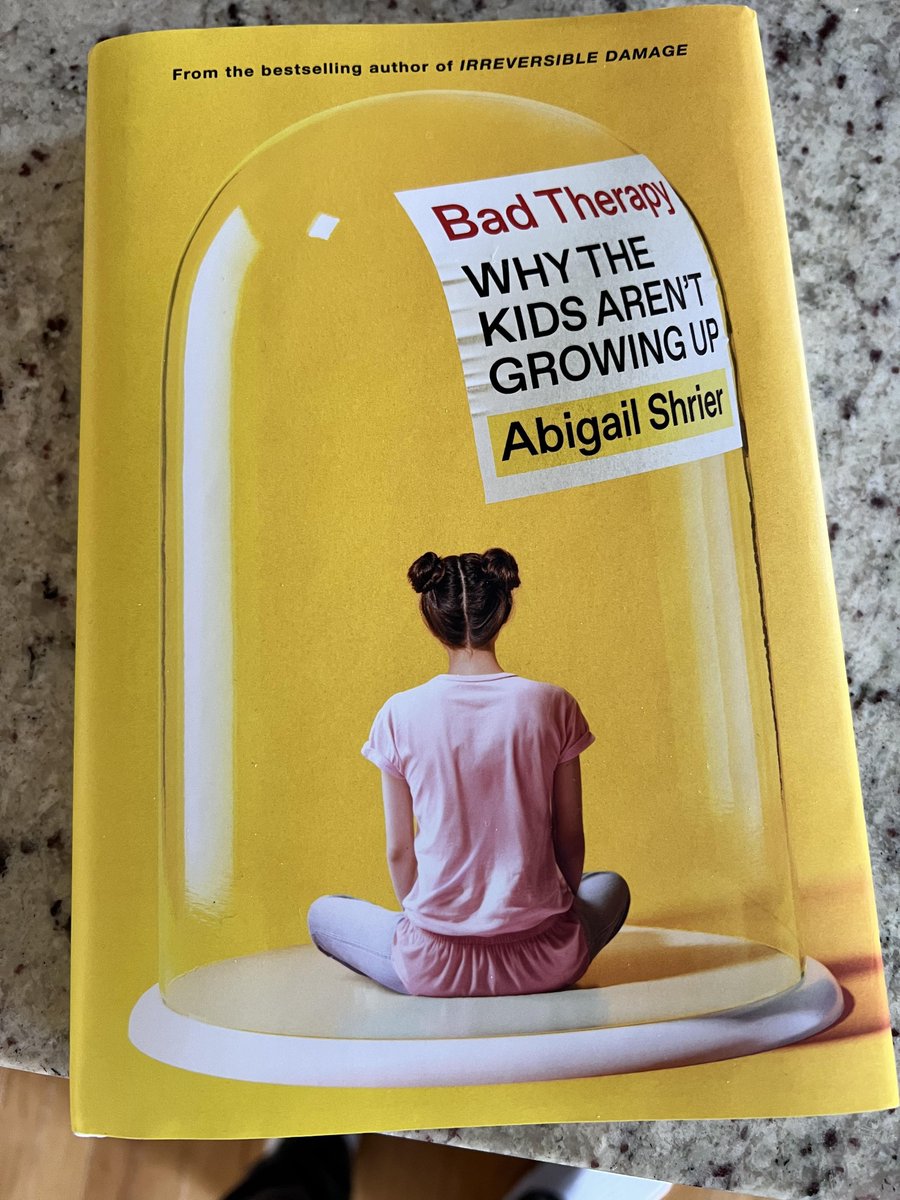
Just finished this book - Bad Therapy by @AbigailShrier
This is one of the most eye-opening books I've ever read. It's a must read for any parent, any teacher, and should be required reading for any school administrator as well.
The book dives into trying to figure out why kids are having so many mental health problems, when there are so many resources devoted to improving mental health outcomes.
Anxiety, depression, suicide, etc are all higher than they've ever been with kids, even though their lives are arguably better than ever before. It just doesn't make sense.
A few key takeaways from the book:
A constant attention on how kids are "feeling" or "thinking" is causing negative outcomes.
Constantly ruminating on your emotions and how you feel negatively impacts your mental health. If all you do is focus on your emotions, you are destined to be anxious or depressed.
We incessantly ask kids how they're feeling, if they're happy, how their mental health is, etc, and this is creating kids who think they're fragile instead of resilient.
Trying to solve every problem for kids has caused a generation who can't do anything for themselves.
We (Gen X) were told to "suck it up" or "you'll live" or "rub some dirt on it" all the time. Many of us came to the conclusion this is "bad parenting" because our feelings were neglected, and we vowed not to do this to our own children.
Because of that, kids immediately over-dramatize everything that happens to them, making mountains out of molehills, and thinking the world must revolve around their emotions and feelings.
You develop confidence and strong mental health by doing things, not by thinking or via therapy.
You can't think your way out of anxiety. You don't gain confidence by analysis of your thoughts or mental health issues.
You gain confidence and eliminate anxiety by doing gradually more difficult tasks, excelling at them, and realizing you are a competent, capable person.
The non-stop attention therapy gives to these small, common emotions we all feel blows them out of proportion to their seriousness (not talking about genuine disorders here, just normal anxieties that millions of people go to therapy to try to avoid).
One of the best ways to decrease your happiness is to chase it.
Our society constantly tells kids they should be "happy" and asks them if they are.
Happiness isn't a state you should be in 24/7. That's not realistic. Joy and bliss aren't permanent states - they are fleeting.
Contentment, stillness, and being even-keeled are much better goals to aim for mentally.
The happiest, most well adjusted kids come from families with loving parents that have strict rules for the household.
This one really set off the confirmation bias in me... I feel really blessed we have 2 well adjusted middle school kids who do great in school, are very respectful and well mannered, and we barely even need to parent them.
But for years, we were very strict with them. Bedtimes, family rules, how we do things, etc. The in-laws and lots of friends thought we were totalitarian.
In reality, we just had high standards. And it's really paying off right now. I found it really interesting that strict rules equals happy kids. Makes sense, though, as kids need to know what their boundaries are.
Constantly surveying school-age kids about their mental health causes more issues than it solves.
Mental health resources is big money. Districts need to validate all the resources allocated towards mental health, and they often do that via surveys.
Asking kids non-stop questions like:
- Have you thought about self harm?
- Have you thought about suicide?
- Have you been so anxious you can't get out of bed?
Etc, etc puts into their heads the idea that themselves, or many of their peers are broken and cannot function properly in the real world.
It normalizes situations that would be incredibly rare at any other time in history.
There's a lot of other takeaways, too, but I'll stop there.
It's a fantastic book. Go pick it up and read it. This isn't an affiliate thing or a promotion thing at all. I just really enjoyed it, and it will further shape the way I parent moving forward.